The Sun is about 150 million kilometres from Earth. We cannot touch it, collect samples from its surface or easily travel close to it. And yet, we know what it is made of, how hot it gets and how its activity changes over time.
The key is light. The radiation we receive from the Sun carries information about its different regions, chemical composition, temperature and the motion of the gases that make it up. To capture and interpret that information, we use spectrographs, telescopes equipped with specialised filters, and instruments aboard space missions.
We may not be able to travel to the Sun, but the Sun is constantly sending information our way in the form of light. By learning how to read that light, we can study the Sun using:
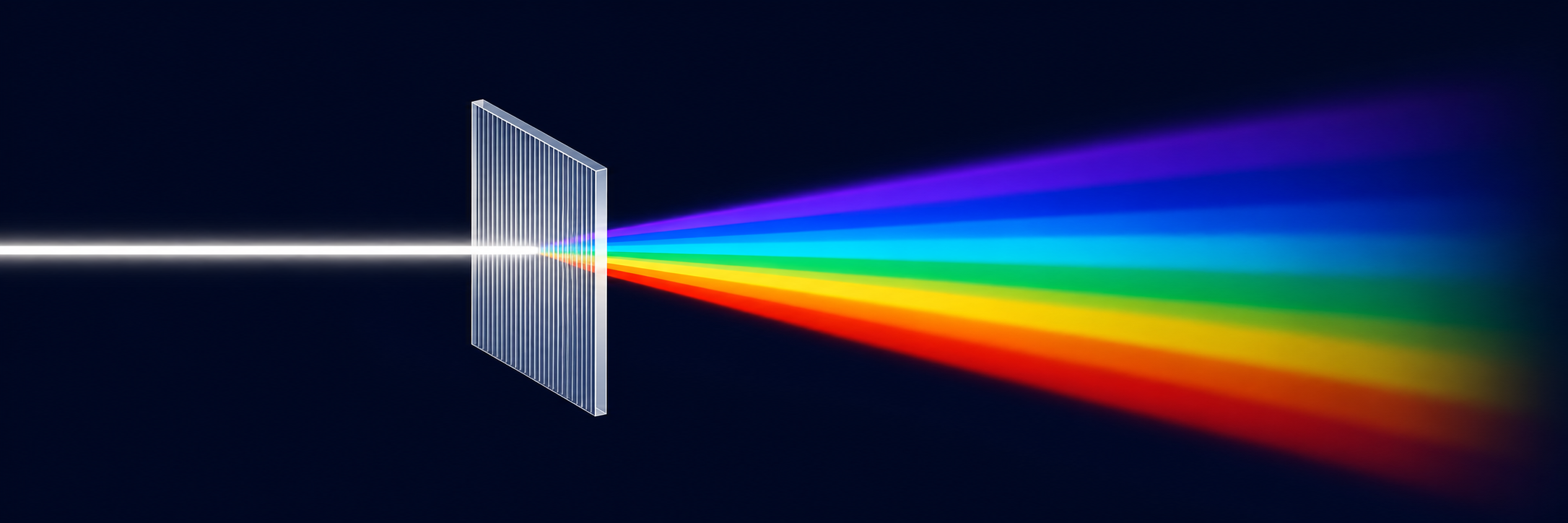
At first glance, all the Energy emitted by the Sun in the form of electromagnetic waves. Visible light is only a small part of it. appears to reach us all mixed together. A An instrument that separates and records light. In simplified terms, it consists of an entrance slit, an optical system that forms the light beam, a diffraction grating and a detector. allows us to take a small sample of that light: the slit lets through a narrow strip, the optical system turns it into a beam, and the A surface containing a very large number of parallel grooves. Each wavelength is deflected at a different angle as light passes through or reflects off it. separates it according to its The distance between two equivalent points on a wave, such as two consecutive crests. Wavelength allows us to distinguish between different types of radiation.. A detector can then record the resulting A representation of radiation arranged by wavelength. It can be displayed as a continuous band or as a set of curves., allowing us to break the Sun's message into separate signatures that we can analyse individually.
Slide to follow the journey of light: it first passes through the slit, forms a beam and is then separated according to wavelength.
Explore the electromagnetic spectrum
The light we receive from the Sun belongs to a much broader family: electromagnetic radiation, which travels through space as continuous waves. Each wave can be described by its wavelength (the distance between two crests), its frequency and its energy. The shorter the wavelength, the higher the frequency and energy. Terms such as “radio”, “infrared”, “visible” and “X-rays” identify different regions of the continuous electromagnetic spectrum.
Select a region to see how the wave changes and what kind of solar information an instrument can detect.
Longer wavelengthShorter wavelength
Shorter frequency and energy per A photon is a small unit, or “packet”, of energy that makes up light. The shorter the wavelength, the more energy each photon carries.Longer frequency and energy per photon
Important: a photon carrying more energy does not necessarily pass through Earth's atmosphere more easily. Different gases absorb different wavelengths. This is why much of visible light reaches the ground, while most ultraviolet radiation and virtually all X-rays and gamma rays are blocked or absorbed. The boundaries shown between regions of the spectrum are approximate, and the band widths have been adjusted for readability; they do not represent the actual size of each wavelength interval.
Wavelength: intermediateEnergy per photon: intermediate
Visible light
Wavelengthnm stands for nanometre: 1 nm equals 10⁻⁹ m, or one billionth of a metre.
FrequencyHz stands for hertz: one oscillation per second.1 THz equals 10¹² Hz: one trillion oscillations per second.
Energy per photonThe electronvolt (eV) is a unit of energy. It is the energy gained by an electron when it moves through an electric potential difference of one volt; 1 eV equals 1.602 × 10⁻¹⁹ joules.
Scale and size reference
This is a tiny region of the spectrum: the thickness of a human hair corresponds to roughly one hundred visible wavelengths. Visible photons carry more energy than infrared photons and less than ultraviolet photons.
🗽📏✺⚛Human hair≈ 70 µm thick
Earth's atmosphere
Largely passes through
Much of visible light passes through the atmosphere. This is not because visible light lies near the centre of the spectrum, but because atmospheric gases absorb relatively little radiation at these wavelengths.
The narrow band our eyes can see
Of the entire electromagnetic spectrum, the human eye can detect only a very narrow region: visible light, extending approximately from 380 to 700 nanometres. Within this interval, each wavelength is associated with a colour, from violet to red.
When we enlarge this region, we find that the brightness of the rainbow is not perfectly uniform. Before leaving the Sun, light travels through gases in its atmosphere, where some atoms absorb photons at very specific wavelengths. We still receive light at those wavelengths, but at a lower intensity, so a spectrograph records these small dips as absorption lines. Because each element produces a characteristic pattern, these lines preserve direct information about the solar gas and act like fingerprints that we can recognise.
How do we study them? A spectrograph records the position, intensity, width and shift of each line. A telescope equipped with a very narrow filter can then isolate one of these wavelengths to produce an image of the Sun.
Select a dark line to discover which element leaves that signature and what it can tell us about the Sun.
380 nm · violet500 nm600 nm700 nm · red
393.4 nmIonised calcium (Ca II)
Calcium K line
“Ionised” means that the calcium atom has lost an electron. This line responds strongly in magnetically active regions of the Sun and can be used to study the lower chromosphere.
What can these lines tell us?
Where a line appears is only part of the story. Its intensity, width and any small shift in position provide additional information.
HCaNaChemical composition
The position and pattern of the lines identify the atoms or ions present, such as hydrogen, calcium or sodium.
Physical conditions of the gas
The intensity and width of spectral lines help us estimate temperature and other physical conditions in solar material.
←→Motion of solar gases
If a line shifts from its usual position, the A change observed in light caused by the motion of the gas: if the material moves towards us, the line shifts to shorter wavelengths; if it moves away, it shifts to longer wavelengths. reveals whether the material is moving towards or away from us.
From spectrum to image: we have seen how a spectrograph analyses an absorption line and extracts information about solar gas. Now let's see how a solar telescope uses specialised filters to isolate a very narrow band around one of these lines and create an image of the Sun.
One Sun, different ways of seeing it
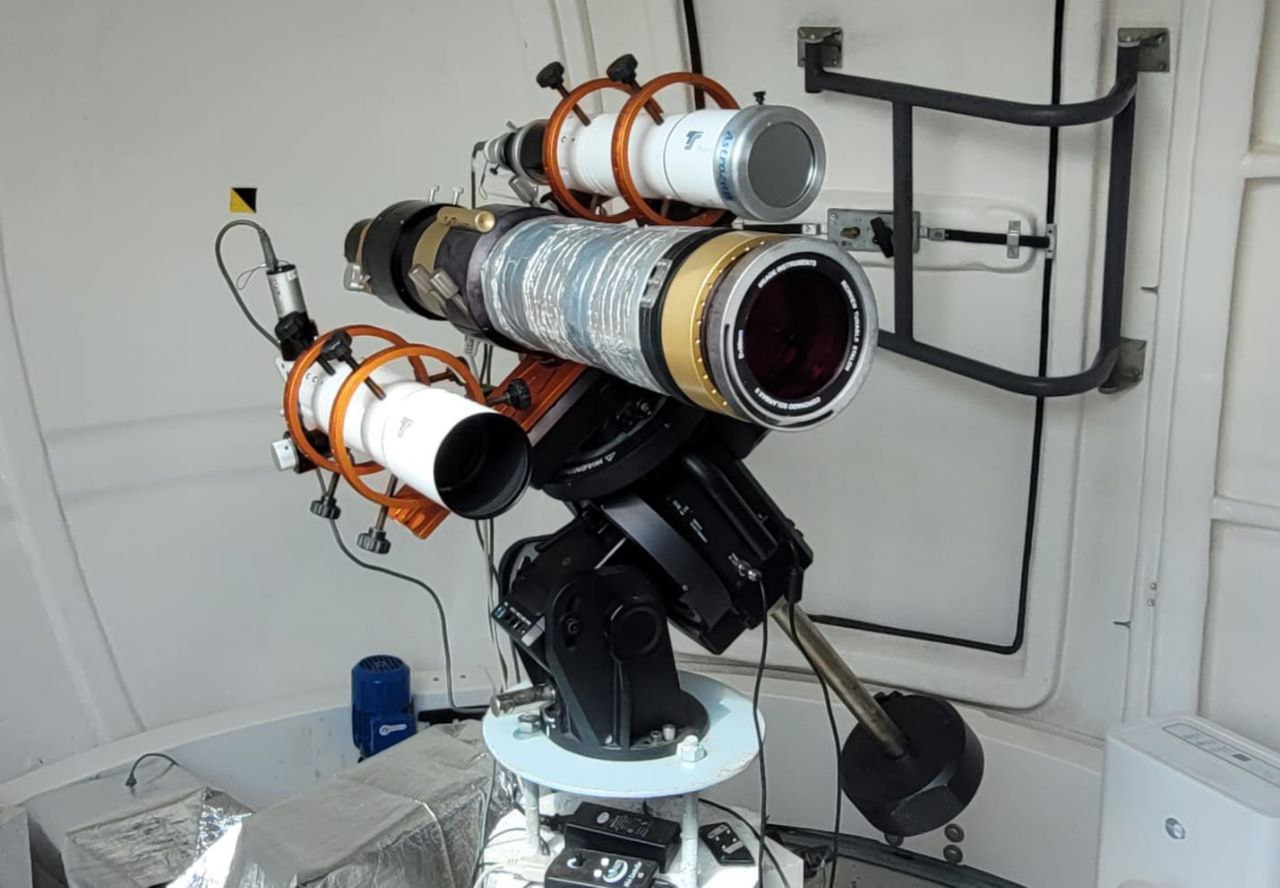
A solar filter is an optical element designed to transmit a very narrow band of light while blocking the rest. When used with a solar telescope, it allows us to isolate a specific wavelength and reveal structures that would remain hidden if we observed all wavelengths at once. This is why the same Sun can look so different depending on the filter used.
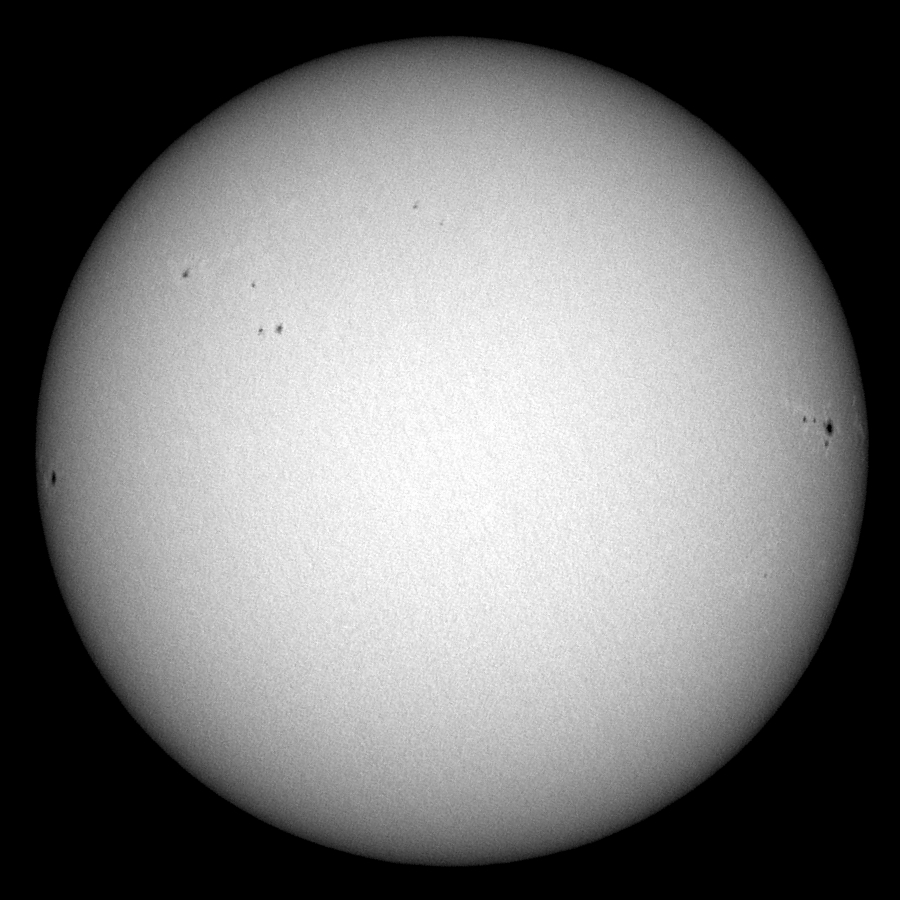
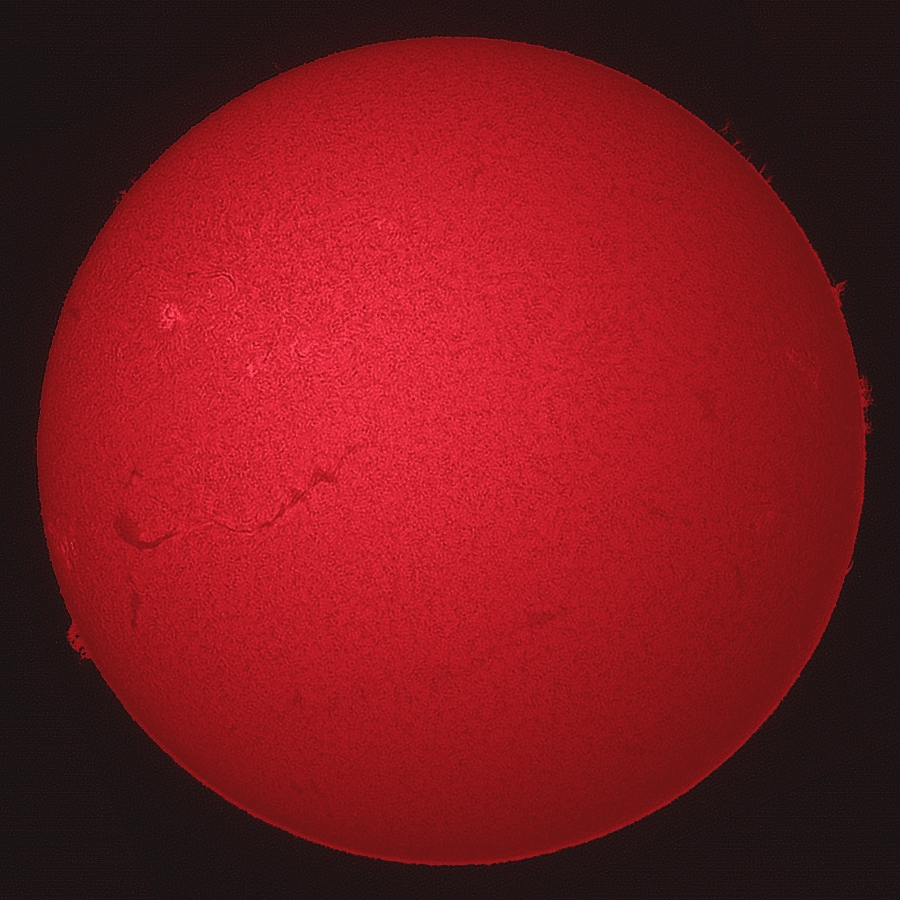
The visible-light image serves as our reference. Here we can identify sunspots, which appear darker because they are cooler than their surroundings and are associated with strong magnetic fields. Select the H-alpha or Calcium-K filter and drag the vertical white line to discover what each observation reveals.
H-alpha · chromosphereVisible light · photosphere
Helios Observatory · 12 Mar 2026H-alpha 10:06:37 · Visible 10:06:57
H-alpha filter656.28 nanometres
This filter isolates a very narrow band around the hydrogen H-alpha line, the same absorption signature identified earlier. Because this wavelength lies in the red part of the visible spectrum, the image appears in reddish tones. By forming an image using only this light, we can reveal the chromosphere and highlight prominences, filaments, spicules and solar flares associated with the Sun's magnetic activity.
Look for: elongated structures, arcs extending beyond the solar limb, and particularly bright regions.
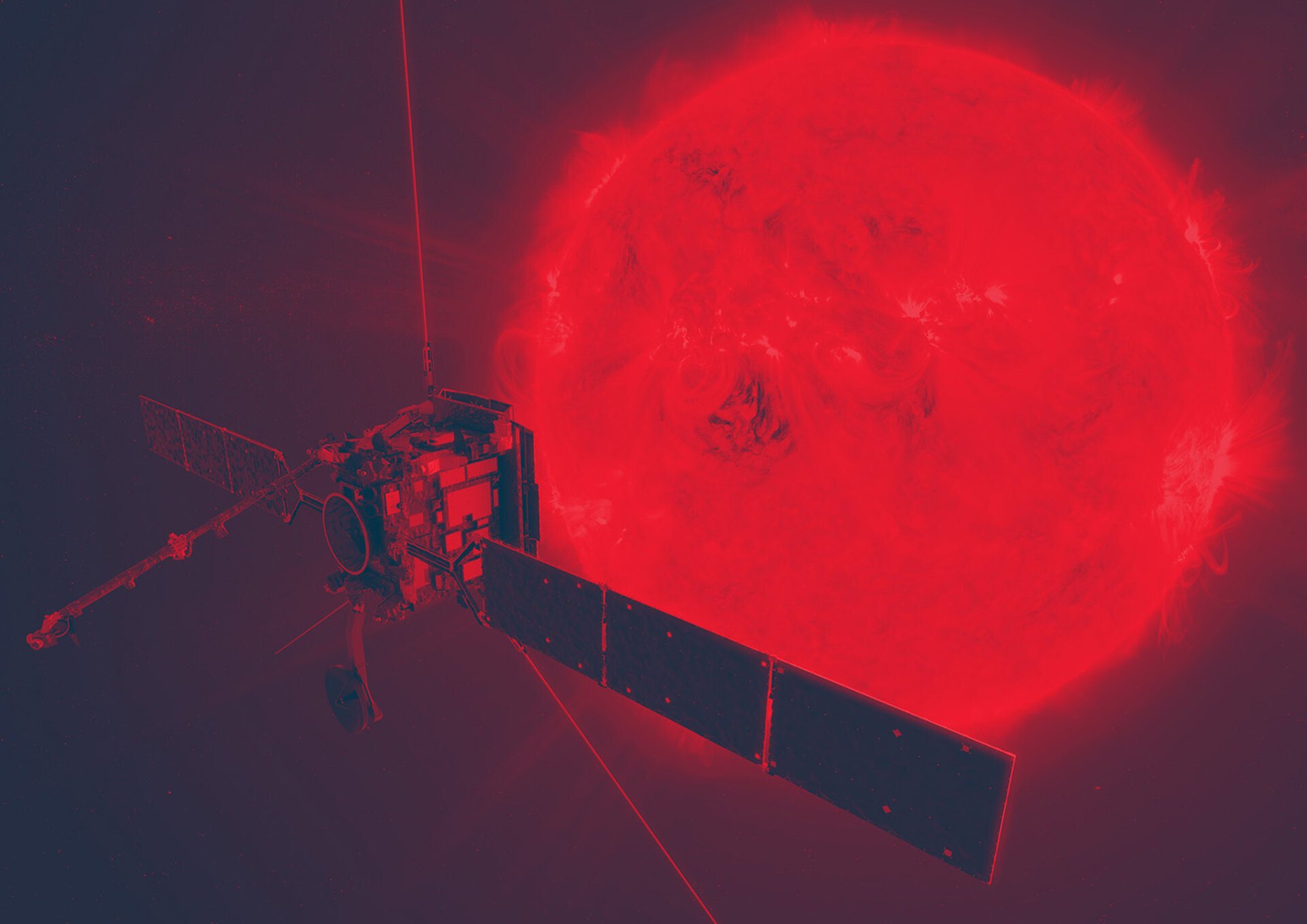
Earth's atmosphere only allows certain windows of the electromagnetic spectrum to pass through. It absorbs much of the ultraviolet and infrared radiation and blocks virtually all X-rays and gamma rays. This is why we rely on space missions to study regions and phenomena of the Sun that cannot be fully observed from Earth's surface.
Analysing spectra, observing through specialised filters and placing instruments above Earth's atmosphere are three complementary ways of answering the same question: what is sunlight telling us about the Sun?