The Sun is an enormous sphere of extremely hot gas that produces its own light. It is about 4.5 billion years old and acts as a vast powerhouse, with reactions in its interior transforming one element into another. The energy released reaches us as light and heat, making life on Earth possible.
Type of star
The Sun is a G2 V yellow dwarf: a mature, stable, medium-sized star that shines by producing its own energy.
Energy on the move
Some of this energy travels through space as light. Light is the fastest thing we know in the Universe, but even its journey to Earth is not instantaneous.
Centre of the system
Its enormous mass makes the Sun the dominant body in the Solar System: it contains close to 99% of all its material. Planets, asteroids and comets account for only a tiny fraction.
The main sequence: the Sun's engine
The Sun is currently in a long, stable stage of its life known as the main sequence. During this phase, the star remains in balance: gravity pulls matter towards the centre while the energy produced by nuclear fusion pushes outwards.
Every star follows a natural life cycle in which it forms, ages and eventually dies. For a medium-sized star such as the Sun, this stable stage lasts for billions of years. Understanding how hydrogen fuses into helium is therefore key to explaining why the Sun can shine for so long.
Nuclear fusion in action
Press the button to see a simplified representation of how several hydrogen nuclei can combine to form helium and release an enormous amount of energy:
H
H
H
H
He
Hydrogen in the solar core
Fusion in the Sun releases approximately 3.8 × 1026 joules of energy every second. To put that scale into perspective, this is comparable to the energy humanity would consume over more than half a million years at today's annual global rate.
This animation is a conceptual model. It does not reproduce every step of the real process, but it helps visualise the transformation of hydrogen into helium and the release of energy.
The structure of the Sun
The Sun can be represented as a structure made up of several distinct regions. Some lie within its interior, where energy is generated and transported; others form the solar atmosphere, where that energy is emitted and many phenomena can be observed. Select each region of the model, or its label, to discover what happens there:
Core
The core is the central and hottest region of the Sun, reaching temperatures of around 15 million °C. This is where nuclear fusion takes place: hydrogen nuclei combine to form helium, releasing the enormous amount of energy that powers the Sun.
Exploring: Core
This diagram is a conceptual model for comparing the regions; the layers are not shown to scale.
Explore the structure in 3D
The previous model provides a guide to the Sun's main regions. You can now explore a three-dimensional representation to see how these layers relate to one another and to other visible features of solar activity.
Model labels: core; radiative zone; convective zone; photosphere; chromosphere; corona; sunspot; coronal loop; coronal mass ejection; granulation.
Why study the Sun during an eclipse?
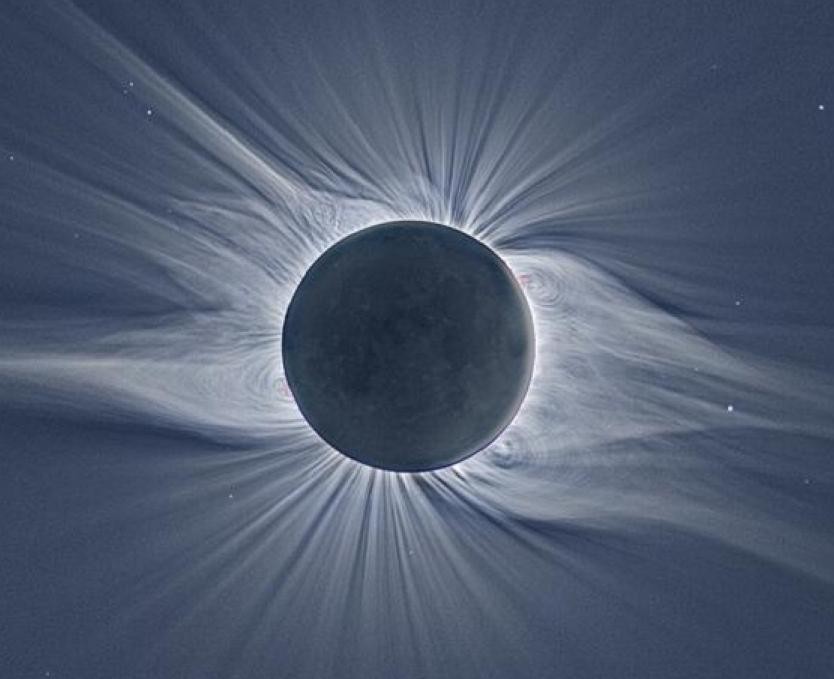
During a total solar eclipse, the Moon hides the photosphere, the brightest part of the Sun. With its glare briefly blocked, fainter regions of the solar atmosphere and some features associated with solar activity become visible. Learning about the Sun's structure before observing an eclipse helps us recognise what we are seeing and understand why these moments are so valuable to science.
Solar corona During totality, it appears as a faint halo around the hidden solar disc.
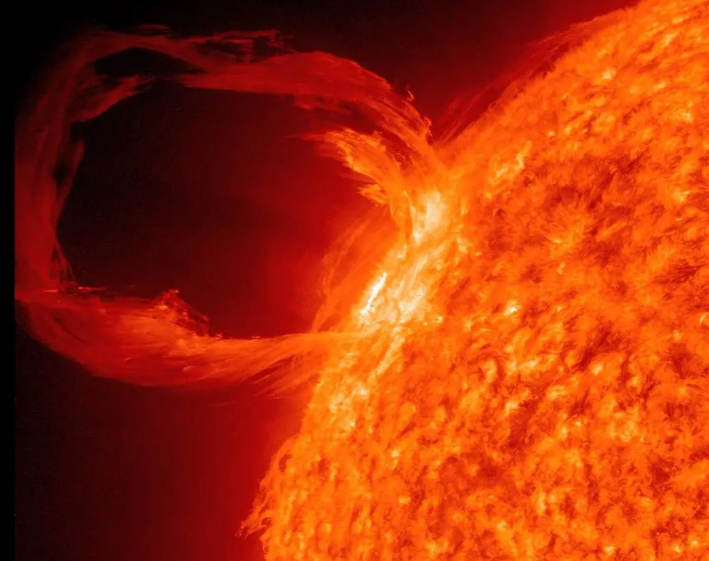
Solar prominences These reddish structures of plasma can be seen extending beyond the Sun's edge.
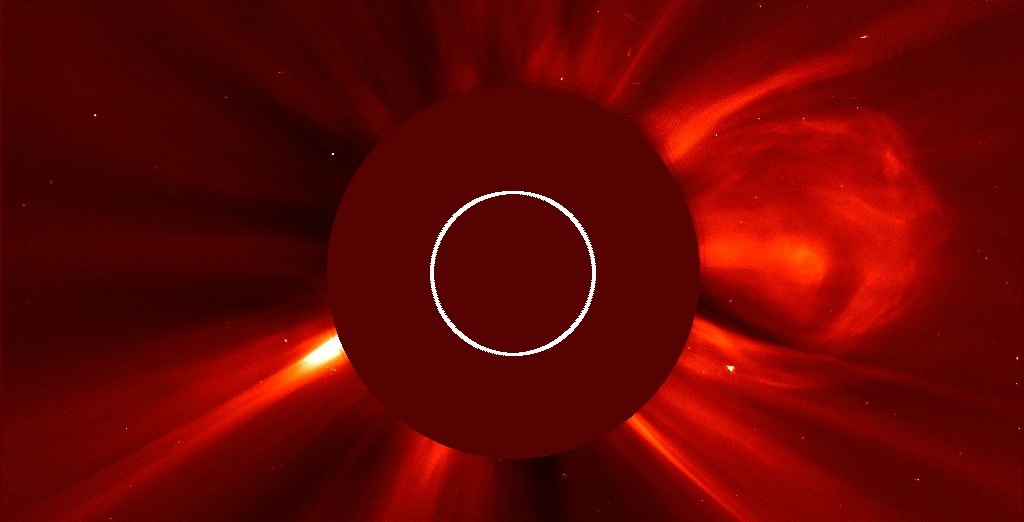
Coronal mass ejections Eclipses can help scientists trace how these eruptions interact with the corona.